
Liquid Supercar That Promised to Change Everything
Welcome to the most comprehensive Quant F UK car review you’ll find anywhere. This Liechtenstein-built, zero-emission, four-door supercar still turns heads years after its debut because it doesn’t run on lithium batteries, hydrogen or petrol – it runs on two tanks of ionic liquid (essentially safe, non-flammable, non-toxic “liquid salt”). Refuel in under five minutes, drive 500 miles, produce 1,075 horsepower and emit absolutely zero CO₂. Sounds too good to be true? That’s exactly why the Quant F remains one of the most fascinating “what-if” stories in modern automotive history.
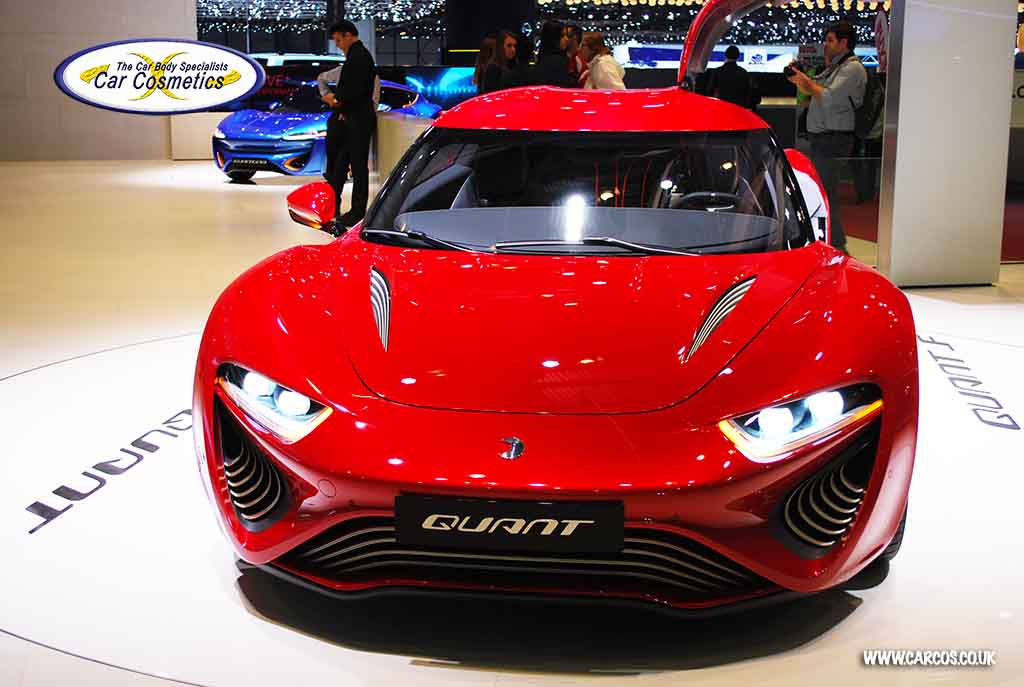
The Story Behind nanoFlowcell and the Quant F
nanoFlowcell AG was founded by Nunzio La Vecchia with one mission: to prove that flow-cell technology could outperform traditional batteries and hydrogen fuel cells. Their first car, the Quant E (2014), stunned the Geneva Motor Show. The follow-up, the Quant F (revealed 2015, updated continuously since), took everything further – more power, better efficiency, dramatic new styling and the same core promise: a true zero-emission supercar you could actually refuel like a normal car.
Unlike hydrogen fuel-cell vehicles that need compressed H₂, or battery EVs that take 20–60 minutes to fast-charge, the Quant F uses two separate 250-litre tanks – one positively charged ionic liquid, one negatively charged. When pumped through the patented flow cell, the liquids generate electricity directly, powering four electric motors (one at each wheel). The “Spent” liquid is stored separately and can be swapped or recycled at a filling station in minutes.
Exterior Design – Still One of the Wildest-Looking Cars Ever Built
The Quant F measures 5,257 mm long (longer than a long-wheelbase Mercedes S-Class), yet it looks like a spaceship royalty. Key styling highlights:
- Signature gullwing doors that incorporate both front and rear doors into one huge panel
- Double-bubble roof flowing seamlessly into the rear glass
- Narrowed A-pillars for better visibility
- LED headlamps with wave-pattern daytime running lights
- Massive front grille flanked by huge air intakes with wave inlays
- 22-inch dynamic alloy wheels
- Retractable rear spoiler that deploys above 50 mph for extra downforce
- Ultra-compact rear end dominated by a full-width diffuser and razor-thin LED tail lights
The entire body is crafted from carbon fibre over a monocoque chassis, keeping weight surprisingly low for its size.
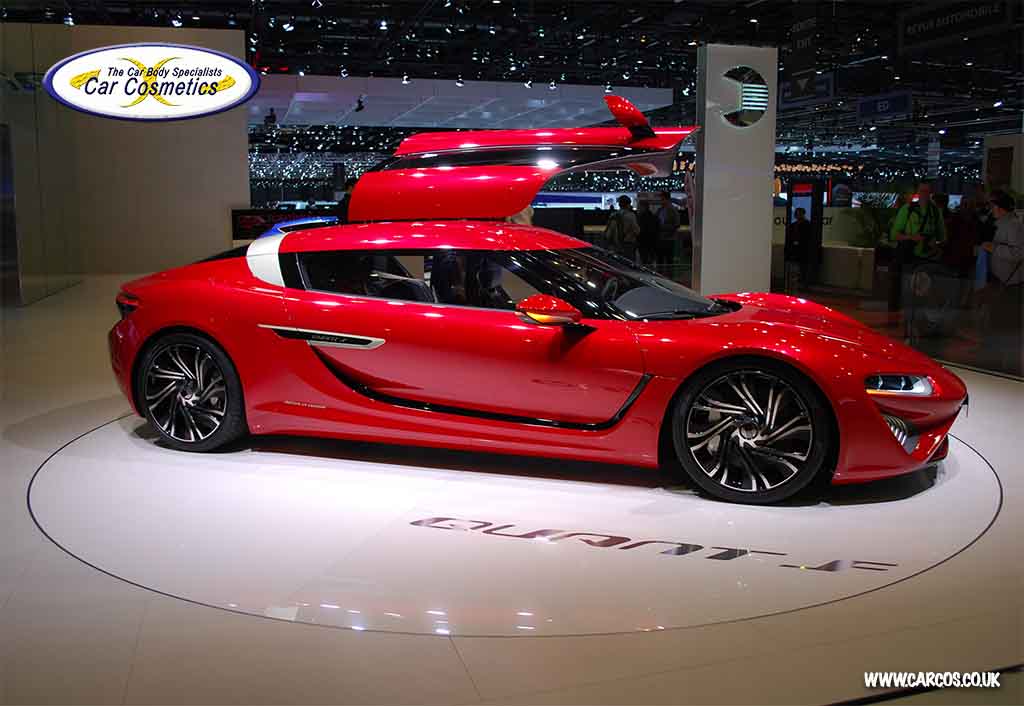
Interior – Sci-Fi Luxury for Four
Open those enormous gullwing doors and you step into a cabin that still looks like 2035 arrived early:
- Four individual bucket seats wrapped in premium leather and Alcantara
- One single curved screen stretching almost the full width of the dashboard – no physical buttons except two rotary knobs for climate control
- Real wood centre tunnel running uninterrupted from dashboard to the rear seats, with embedded LED mood lighting
- Flat-top/flat-bottom steering wheel with integrated touch controls
- Ambient lighting strips that glow along the wood console for the entire length of the cabin
According to nanoFlowcell, the exterior was 100 % ready for type approval and the interior 90 % complete – the only things missing were final crash-structure tweaks.

Performance & Drivetrain – 1,075 hp of Instant Torque
Power comes from four liquid-cooled electric motors (one per wheel) producing a combined 1,075 hp (802 kW) and a monstrous amount of torque. Voltage in the prototype reached 735 V, but production versions would drop to a safer 400 V.
The clever part is the in-house two-speed automatic transmission:
- Normal driving = all-wheel drive for traction and efficiency
- High-performance mode = front motors disconnect, sending everything to the rear wheels for pure supercar feel
Claimed 0–62 mph (100 km/h) is under 2.8 seconds and top speed is electronically limited to 186 mph (300 km/h) – although the company hinted the hardware could go much faster.
Range & Efficiency – 500 Miles on a 5-Minute Fill-Up
Thanks to improved cell chemistry and larger tanks, the Quant F offers up to 800 km (500 miles) on a single fill – roughly 30 % better than the original Quant E. Energy density is claimed to be five times higher than lithium-ion batteries, with none of the fire risk or rare-earth mining issues.
Refuelling? Pull up to a (theoretical) nanoFlowcell station, swap both tanks in minutes and drive away – no waiting, no range anxiety.
Infrastructure Challenge – The One Thing That Stopped It
Here’s the honest truth: the technology works in the lab and on the prototype, but rolling it out needs new filling stations every 400–500 miles and government backing for the fuel itself. Without that network, the Quant F remains a stunning showcase rather than a showroom reality. nanoFlowcell has always said the car is secondary – the real product is the power technology, which could revolutionise shipping, aviation, trains and grid storage.

10-Point Quant F Review Summary
- Design – 9.8/10 – Still jaw-dropping
- Interior luxury & tech – 9.5/10 – Feels like a concept from the future
- Performance – 10/10 – 1,075 hp with instant delivery
- Innovation – 10/10 – Nothing else like it on the planet
- Range & refuel time – 10/10 – Solves the two biggest EV problems
- Practicality – 6/10 – Four seats but tiny luggage space (tanks take priority)
- Reliability – Unknown – Never independently tested long-term
- Running costs – Potentially very low (if infrastructure existed)
- Real-world availability – 0/10 – Still vapourware for the public
- Wow factor – 11/10 – The car that makes Rimac and Pininfarina look normal
Why the Quant F Still Matters Today
Even if you’ll never buy one, the Quant F proved that there are multiple paths to zero-emission performance. Flow-cell technology is still being researched by universities and startups worldwide. One day we might see ionic-liquid filling stations – and when we do, we’ll remember the gullwing-door supercar that showed it was possible first.
Want to read every technical detail, see the full photo gallery and watch the original reveal videos?
Keep Your Current Car Looking Factory-Fresh with Car Cosmetics Mobile Repairs
While we wait for ionic-liquid supercars to hit the road, keep the car you already own looking brand new!
Car Cosmetics – The UK’s No.1 mobile car body repair specialists
✓ Minor to Medium paintwork Repairs
✓ Same-day service at your home or workplace
✓ Up to 50 % cheaper than bodyshops
✓ 1 year guarantee
Call or WhatsApp for instant quote: 07803 242 888 www.carcos.co.uk